

Ganglions
A common condition characterised by fluid-filled lumps on the hand or wrist region
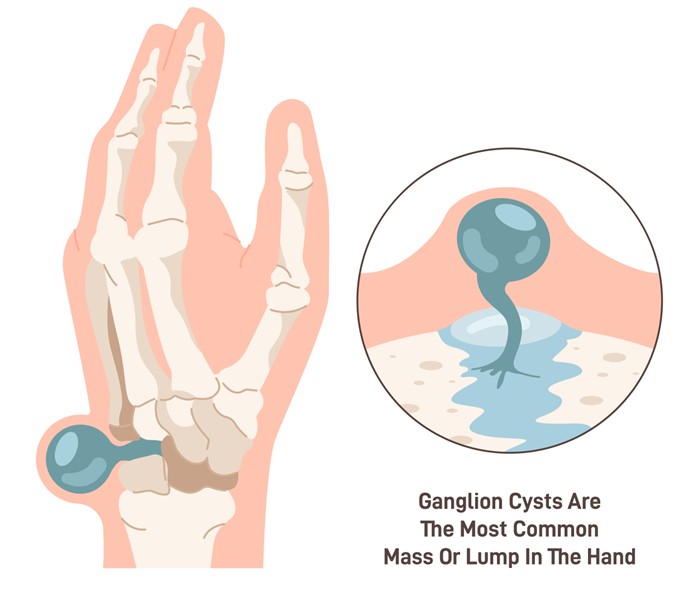
A ganglion cyst is a common, non-cancerous lump that develops near a joint or tendon in the hand or wrist. It is filled with a clear, jelly-like fluid and may vary in size, sometimes becoming more noticeable with activity and reducing when the hand is at rest.
Ganglion cysts often appear on the back of the wrist but can also develop on the palm side, at the base of the fingers, or around the thumb. While generally harmless, they may cause pain, discomfort, or interfere with hand movement if they press on nearby structures such as nerves or tendons.
The exact cause of ganglion cysts is not fully understood, but they are thought to result from irritation or small tears in the tissue around joints or tendons, allowing fluid to collect and form a swelling. They can occur at any age and are more common in women.
Not all ganglion cysts require treatment. Some disappear on their own, while others may need medical attention if they become painful, restrict function, or affect daily activities. Prof Sallen can assess your condition and explain the most appropriate management options based on your symptoms and needs.
Causes of Ganglion Cysts
The exact cause of ganglion cysts is not fully understood, but they are believed to form when fluid from a joint or tendon sheath leaks out and collects in a small sac under the skin. This fluid is similar to the natural lubricating fluid found inside joints, which normally helps them move smoothly.
Several factors may contribute to the development of a ganglion cyst:
- Joint or tendon irritation – Repeated stress or irritation in a joint or tendon may lead to small weaknesses in the tissue, allowing fluid to escape and form a cyst.
- Previous injury – A past injury to the wrist, hand, or finger joints may increase the likelihood of a ganglion cyst forming in that area.
- Joint or tendon wear – Changes in the soft tissues around joints and tendons, sometimes related to overuse or age, may play a role in cyst development.
- Unknown factors – In many cases, there is no clear reason why a ganglion cyst appears. Some simply develop without any obvious trigger.
Ganglion cysts are more commonly seen in younger adults, particularly women, and often occur in people who use their hands repetitively for work, hobbies, or sport.
Symptoms of Ganglion Cysts
Ganglion cysts are characterised by a range of symptoms, which may vary depending on their size and location:
- Visible lump – A smooth, round or oval swelling that commonly appears on the back of the wrist, palm side, or at the base of a finger. The size may fluctuate, often becoming larger with activity and smaller at rest.
- Pain or discomfort – Many cysts are painless, but some may cause aching or tenderness, particularly when pressure is placed on the joint or when nearby nerves are affected.
- Limited range of motion – Larger cysts can restrict normal wrist or finger movement, making certain activities more difficult.
- Tingling, numbness, or weakness – If the cyst presses on a nerve, it may lead to altered sensation or weakness in the hand or fingers.
Diagnosis of Ganglion Cysts
Diagnosis of a ganglion cyst usually begins with a clinical examination. In most cases, the process is straightforward, and additional tests are only needed if there is uncertainty or to rule out other conditions.
- Medical history – Prof Sallen will ask about when the lump first appeared, whether its size changes, and if you have any associated pain, numbness, or weakness.
- Physical examination – The cyst is typically smooth, firm, and moves slightly under the skin. Light pressure may reproduce symptoms.
- Transillumination – A simple test where a small light is shone through the lump. A fluid-filled cyst usually appears translucent, helping to distinguish it from a solid swelling.
- Imaging tests –
- Ultrasound can confirm the presence of fluid and differentiate a cyst from other lumps.
- MRI may occasionally be recommended if the diagnosis is unclear or if there is concern about deeper joint or tendon involvement.
- X-rays – Not usually required to see the cyst itself but may be used to check for underlying joint conditions such as arthritis.
In most cases, a diagnosis can be made with history and examination alone. Prof Sallen will explain the findings and outline whether treatment is necessary based on your symptoms and daily needs.
Treatment Options for Ganglion Cysts
Not all ganglion cysts need treatment. If the cyst is painless and does not affect function, observation alone may be appropriate. When symptoms are bothersome, several treatment options are available:
- Observation
- Some ganglion cysts shrink or disappear on their own.
- Regular monitoring may be recommended if the cyst is not causing pain or limiting movement.
- Splints and activity modification
- Wearing a wrist splint can help reduce movement-related discomfort.
- Adjusting or avoiding repetitive hand activities may reduce irritation and swelling.
- Aspiration (drainage)
- The cyst can sometimes be drained using a needle under local anaesthetic.
- This may provide relief, although cysts often return because the cyst lining remains intact.
- Corticosteroid injection
- In selected cases, a steroid injection may be given after aspiration to help reduce inflammation and the chance of recurrence.
- Surgical removal
- If the cyst is painful, recurrent, or interferes with daily activities, surgical excision may be considered.
- The procedure involves removing both the cyst and its connection to the joint or tendon sheath.
- Surgery is usually performed as a day procedure, and recurrence is less common compared with aspiration.
Recovery and outlook
- After treatment, many people notice improved comfort and function.
- Following surgery, a short period of rest and hand therapy may be recommended to restore movement and strength.
- Although recurrence is possible with any treatment, surgical removal offers the lowest recurrence rate.
Prof. Sallen will discuss the benefits and limitations of each option with you and guide you toward the most appropriate treatment based on your symptoms, lifestyle, and preferences.